

Blog
Published: March 19, 2025
What Canadian Businesses Can Do to Withstand Tariffs and Trade Wars
It appears Canadian businesses are entering a new climate of uncertainty, given the new and constantly changing tariff policies coming from the US government. While Canadian employees across many sectors are fearing for their jobs, those of us who are business owners are certainly taking a hard look at the operational and marketing changes that need to be made to strengthen our resilience.
My feeling today is similar to five years ago, in March of 2020, and as we all know, that was a heck of rollercoaster for every Canadian business.
Table of Contents
Imagine Your Biggest Client Starts Behaving Badly
Let’s pretend Canada is a single business. Canada’s biggest client is USA. They’ve been the bread-and-butter account for as long as anyone can remember, and a reliable ally. Business owners, many of you have a client like that, right?
However, like any business, when you rely on one large account for more than say 50% of your business, you run a serious risk. The client can strong-arm you, they get unreasonable discounts that affect your profitability, and if they leave you, it’s like cutting off an arm and a leg at the same time. But how bad it is, really?
How much of Canada’s exports go to the USA? A whopping 77% (McNally, 2025).
Clearly, that’s a problem.
So first, I’m going to talk briefly the probable effects of the tariffs, and then I’ll give you some things you can start doing today.
Likely Effects of Tariffs on Canadian Businesses
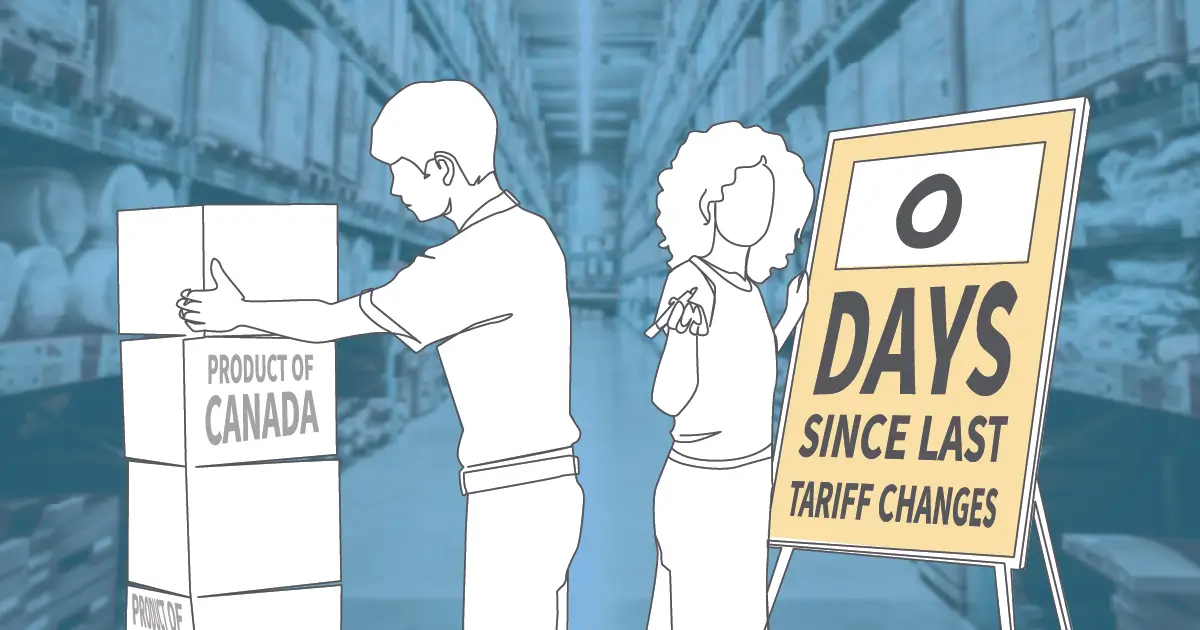
A tariff affects the price of goods crossing the borders. When the US puts tariffs on Canadian goods, it means that US businesses and consumers must pay more for those goods.
But the question is – if were to you raise your prices by 25%, would your customers – whether businesses or individuals – choose to buy elsewhere?
Not necessarily. It depends on how much value you demonstrate – and how well you differentiate your products.
This means that commodities, like energy and lumber – might be hit worse, especially if there are comparable US products, produced in sufficient volumes to take that business.
When you put US tariffs on goods from both Canada (approximately 13.5% of US imports) depending on the sources you check) and Mexico (approximately 14.5% of US imports), that adds up to more – so about 28% of imports going into the US will be increasing in price by 25% (US Census Bureau, 2025). That means that US consumers will likely feel the burden of higher prices, as US companies probably won’t be able to make up those volumes in the short term.
The other side, which is perhaps worse, is new Canadian Tariffs on US goods being imported to Canada Of all Canadian imports, the USA provides 62%* of these (McNally, 2025). This means that by imposing tariffs on US goods coming into Canada, we could see a great jump in inflation here, possibly more than will be felt in the US.
And, I’m not even talking about the effects of massive job losses; when auto manufacturers in Ontario start shutting their doors, and Alberta oil and gas companies start cancelling projects, we might have more than your average recession. There could be an even longer term effect of losing foreign investment dollars, if investors feel Canadian real estate and markets are being threatened by the US. That said, Trump might change his mind after about a week of watching the markets drop like a rock.
What Canadian Businesses Can Do About It
As with the pandemic, there’s a bit of “pray”, for starters. But if you’ve got the guts to get a business going in the first place, you’ve got the guts to save it, if you really want it to be saved.
So, here are my recommendations.
If Your Products are Canadian
However your products are made, if they have Canadian elements, you must point that out to your Canadian customers. Consider whether any of these apply to you:
- Made in Canada
- Designed in Canada
- Assembled in Canada
- Programmed in Canada
- Printed in Canada
- (Sustainably?) Packaged in Canada
- A Canadian-Owned Business
- Employing over (X number of) Canadians
Beyond stating the above, you might also consider adding a Canadian flag or logo to products being distributed in Canada. For example, if you are selling consumer products, now may also be the time to add or design some fun, Canadian-themed versions of whatever they are: Clothing, bags, menu items, drinks, and more.
If You’ve Lost American Customers
If you’ve lost, or are soon to lose, American customers, your marketing and selling efforts can come to the rescue. Here, you have several options:
- Showcase your Value. Entice them to stay, or come back, though pointing out the fantastic value they are getting and how your products are easily worth 25% more than they even realized. Consider that the Canadian dollar already makes many of our goods a great deal for Americans. So you must point out every feature, and as many benefits as possible, for each feature. Even things like warranties and after-sales support matter.
- Consider a discount. If you can afford it, offer a partial price discount…say 12.5%, to split the value of the tariff with your buyer, and only as a temporary measure. I suggest a time limited discount, e.g. 1 week, 30 days, because you may have to suspend this if the tariffs carry on too long, and you’re bleeding cash. Putting a time limit on the discount is more likely to stimulate sales as well. That said, if say, a 12.5% discount constitutes your entire profit margin, or more, then avoid doing this, or adjust to a more appropriate amount. Alternately, you can throw in a free item or service instead of reducing your price.
- Torque up your marketing. Boost your marketing and selling efforts to the maximum to attract new customers. You may even wish to offer incentives to bring new customers on board – such as a bonus (if you commit now, we’ll throw in…) or an introductory discount. To do this, strategize with your sales team about where, how and what kinds of customers you have the best shot of winning in the short term, and make it happen. You may also consider a sales competition within your staff.
- Get all staff to help in selling. If layoffs are imminent, consider offering any staff members a chance to save their jobs if they can bring in one or more new customers, by referral. This may not be possible or realistic in every kind of business, but it might work for some.
- A US office if necessary. If the US is a critical market for you, you could consider setting up a US office with capabilities that allow you to at least partially manufacture in the US. Be sure to consider all the related costs, and whether it is worth it to keep those US customers. This article by a Canadian legal firm covers key considerations of setting up a US office. For help and forms, you can contact Export Development Canada.
If You Source Parts or Materials from the US
Canada’s response to US tariffs will mean that US products will be tariffed – and thus more expensive for Canadian businesses.
- Investigate alternative sources. In fact, it is always wise to have alternative suppliers for every aspect of your business, in case of emergencies. The upside is that not only would this help you avoid tariffs and thus unnecessary price increases, but that you may actually improve your profitability. Given that most of the world is aware of Trump’s aggressive, America-first policies, you may find that Canadian businesses, or other Canadian-friendly countries are very keen to fill the gap.
- Ask existing US suppliers for discounts. If you cannot find a supplier that is better than what one your purchase from in the US, you could consider asking your US suppliers to bargain down their prices or offer better value (include free shipping, for example).
- Find other ways to reduce costs. If you must continue buying from US suppliers, look hard at other ways to reduce your costs. Can you offer customers un-packaged products? Find a warehouse instead of a retail space? Cut your overhead on labour by using AI or other technologies?
- Raise your prices. If the options already mentioned do not find you that 25%, raising prices will be necessary, even if it’s just enough to make up the difference. When raising prices, there are some diplomatic techniques you should use, as described in this previous Tenato article. However, given the high-profile nature of tariffs, price increases will be less difficult. That said, if you can make them less than 25%, you can show your customers that you’ve also made the effort to keep your prices increases lower, this may help you gain market share from other Canadian competitors.
Need more help and ideas?
Like the pandemic, North American trade war will be a bumpy ride for businesses. Just remember that regardless of the pricing, there is still a need for your goods. Now is the time to be agile in finding new customers, new vendors, and new ways of marketing. Tenato Strategy is here to help you, contact us today or book a consultation.
McNally, J. (2025, January 31). Canada-US trade: Getting up to speed. Canada-US Trade: Getting Up To Speed | Post. https://www.scotiabank.com/ca/en/about/economics/economics-publications/post.other-publications.canada-and-us-economics-.canada-and-us-decks.trade-stats–january-31–2025-.html
US Census Bureau. (2025, January). Top Trading Partners – January 2025. United States Census Bureau. https://www.census.gov/foreign-trade/statistics/highlights/topyr.html
Author

We offer a free no obligation initial consultation by phone or virtual meeting:
Book Free Consultation
Categories
Blog
Branding
Business Planning
Eccentric Ramblings
Event Planning
Keynote Speaking
Market Research
Marketing & Media Channels
Marketing Industry Events
Marketing Industry Insights
Marketing Services
Marketing Strategy
News at Tenato
Online market research
Online Marketing
Pricing Strategy
Public Relations
Sales and Business Development
Social Media
Strategic Planning
Tourism Marketing